• Skip to primary navigation
  • Skip to main content
  • Skip to primary sidebar
  • Skip to footer

Mount Prospect Historical Society

#wrap

  • About Us
    • Our Museum
    • History
    • Virtual House Tour
    • Hometown History Video Series
    • Vanished Mount Prospect
    • Guided Tours of Dietrich Friedrichs Historic House Museum
    • Presentations
    • Dollhouse Tours
  • Shop
  • Volunteer
  • Donations/Membership
    • Donate
    • Donate an Artifact
    • Giving Tuesday
    • Membership
  • Events
    • Game Nights
    • Holiday Housewalk 2025
    • Saturday Afternoon Teas
    • Bessie’s Workbasket
    • Evening Creations
    • MPHS Book Club
    • Youth Programs
    • Cemetery Walk at St. Paul Lutheran Cemetery
  • Newsletters
  • Central School
    • For Educators
    • Donors
  • Research Resources
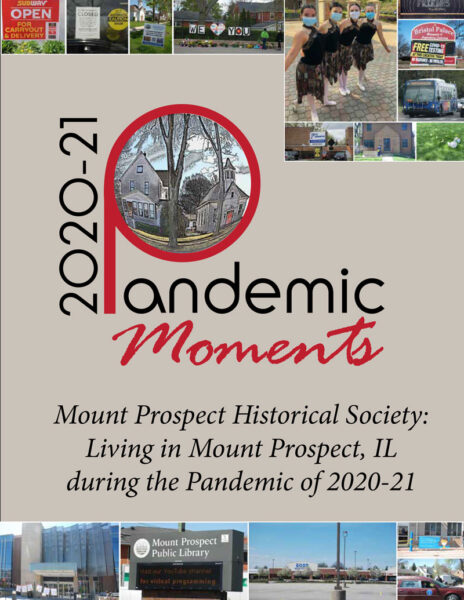
    • Pandemic Moments 2020-21
      • COVID-19 Survey 2021
      • Contributing to Pandemic Moments
      • Personal Accounts
      • Youthful Insights
      • Contact Release Form web format
      • Contact Release Form in PDF format
      • Pandemic Reflections
    • Mount Prospect Businesses
    • Churches of Mount Prospect
    • Essays on Mount Prospect’s History
    • Houses of Mount Prospect
    • Lost and Found Mount Prospect
    • Mount Prospect People
    • Schools of Mount Prospect
    • Mount Prospect Stories
    • Structural Memorials
    • Other Sources for Research
    • Centennial 2017
    • Neighborhood Walking Tours
  • Subscribe!

HS Board

October 19, 2023

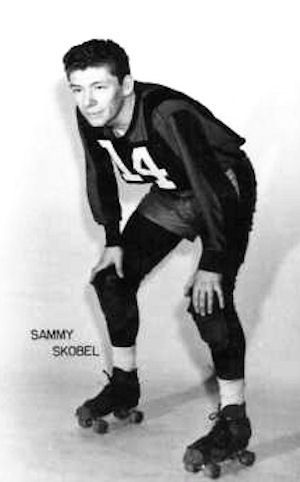
Samuel “Sammy” Skobel

Samuel “Sammy” Skobel was an American roller derby skating star who opened a hot dog restaurant in Mount Prospect after his retirement from his sport.

Legally blind, Skobel was a derby star who was voted most valuable player in the league three times and inducted to the Roller Derby Hall of Fame in 1953. Skobel also held the world record for the fastest mile skated on a banked track – accomplished in 1958.

Sammy was born to Russian immigrants on April 26, 1926. His parents owned a grocery and meat market on Chicago’s Maxwell Street. 

An infection with scarlet fever at the age of four left him legally blind, with less than ten percent of his vision remaining. 

A track star at Crane Technical High School, he ran a 4:22 mile and was offered full scholarships to three universities, but those offers were rescinded when the schools learned he was legally blind. He had a hard time finding and maintaining a job after graduating from high school. In fact, he was denied a job in an electronics factory and got fired from a job repairing innertubes after just a few hours.

In 1945, Skobel tried out for the roller derby at the Chicago Coliseum but was rejected after the general manager of the Roller Derby watched him struggle to fill out the application with a magnifying glass. Instead, Skobel joined the roller derby working as a locker attendant, earning 50 cents per day.[ He worked in the center of the banked-track ring, memorizing the styles and outlines of the skaters. When he heard that the derby was holding tryouts in Chattanooga in January 1946, he traveled there by bus and was able to keep his low vision a secret during trials. He signed with the Brooklyn Red Devils in 1946, keeping his disability a secret for the first five years he played. Skobel would listen for the sound of an opponent’s skates coming up behind him, and if a skater was close he could see whether they were wearing stripes or certain colors.

In 1949, Skobel became the youngest team captain in the history of the sport. Skobel was traded to the Chicago Westerners in 1953, where he skated for twelve seasons. He skated for the IRDL Midwest Pioneers from 1964 to 1966. He had several nicknames throughout his career, including “Slammin'” Sammy Skobel and “Gunner” Skobel. 

Skobel was voted the league’s Most Valuable Player of the year three times during his skating career and was on 18 all-star teams. He was one of the first seven people inducted to the original Roller Derby Hall of Fame in 1953 and in 1958 set a world record fastest mile on a banked track, skating the mile in 2 minutes and 36 seconds.

By the end of his career, he was paid $80,000 each season. He skated his last game in May 1966, but would later serve as a consulting coach for the San Francisco Bay Bombers.

Skobel married his wife Acrivie (“Vee”) in 1952. They had two sons together, Sam Jr. and Stephen. 

After retiring from the roller derby, he opened Sammy Skobel’s Hot Dogs Plus in downtown Mount Prospect. He ran the restaurant from 1965 to 1989, when he sold it to a former employee. He also traveled as a motivational speaker, giving talks on “Creating a Positive Attitude for Life,” and advocated for other blind athletes. For instance, in 1971 he helped found the American Blind Skiing Foundation. 

In 1982, Skobel collaborated with a freelance writer to write his autobiography, titled Semka. The jacket described the book as the “story of a determined young blind man from his boyhood in Chicago’s Maxwell Street to a professional athletic career, setting a world speed skating record.”

Skobel died on June 9, 2018 at age of 92 in his home in Mount Prospect. 

Filed Under: People of Mount Prospect

January 30, 2023

Living During COVID

by Carlos Medina

January 25, 2023

It was March of 2020 when school was canceled. I thought I was taking a full vacation, yay yay. I saw kids running excitedly out the doors with bright smiles, I was one of them. Of course, I figured I would return back to school in a couple of weeks at most, so I might as well enjoy this leap of absence. I would later find out that was not going to be the case.

The first week was amazing, free of homework, quizzes, and tests. I didn’t even talk to my friends during this first week because I felt fulfilled by my own company. However, as days passed, I began to get bored. I got tired of not doing anything productive. It was also starting to become apparent that going back to school was not a real option, and that scared me.

Establishments like Walmart, Target, and Costco, were having shortages of supplies and were mostly deserted. If I did go to stores, there would be a limit of people who entered, and in most places children were not allowed. For that reason, I stayed in my house, not going anywhere for almost a year. To say the least, I still do not know how I kept my sanity. I was irritated most of the time because I was sick of traveling from my room to the living room to the bathroom, and back again. At most, during the summer months I could go to my backyard and swing on my swing. There, on my red swing, it was like I was flying and my worries temporarily disappeared. But once the winter and fall months hit, it was another story. Of course, I was grateful that my parents still had their jobs and my life needs were met, but it still wasn’t comfortable.

By week four, I started to FaceTime my friends, and loneliness was slowly creeping up on me. Finally, by week nine or ten, remote learning began. It was so strange to transform my environment of relaxation to be a workplace. Speaking of workplaces, a couple weeks after remote learning started, my father had been let go, and was searching for a new job. My mother, who was working a small side job, was our only source of income. Things were starting to take a turn, and the worst part was that I felt it. I saw how things were spirling, and I felt my insides turn. In the beginning of remote learning, it was fine because I was given a list of things to do, and there was no camera watching me complete it. There wasn’t a strict schedule other than everything had to be due by 3pm, but I would still treat it like school because I wanted organization in the midst of all the chaos. However, although it worked for me, it did not work for everyone and so Zoom moved into the picture. Zoom was a pain for so many reasons. Primarily, having to stare at a screen non-stop for hours put a strain on my eyes, which made me buy blue light glasses. Then, the glitching on both my screen and teachers’ screens. If I was put in a breakout room, unless I was friends with the other person, it was so silent that even a whisper would be considered a shout. It was an overall terrible experience because I felt like I was being scrutinized.

Opportunities to go back to school arose, but I wanted to stay at home. I would later regret my decision because staying at home put me in a deep depressive state. It came in waves, but I would cry a lot, all the time. I started to feel anxious during remote learning, and could not focus as well as I had in the beginning. It was because I did not really socialize much with anyone other than my parents that I felt isolated only from the world and got lost in my webs of thought. It all went away, once I returned to school, but it was different. Kids were wearing masks, so I could not recognize anyone. I felt a shift in my peers emotionally too. I think after the pandemic I saw more kids with anxiety and depression than before, and it was understandable. I also felt that there was more separation between friend groups and cliques, whereas before the pandemic I felt like we were more of a connected school.

During lunch, instructions were given for students to be distant from each other, and even had us put up clear plastic paperboards to minimize chances of catching COVID. Then there was the testing; every week I had to spit in a tube sample where I would then be tested for COVID. All the changes were overwhelming me, and it made me hope that this was not going to be the new “regular.” Luckily, as time went on, life was starting to regulate like it used to be pre-pandemic. As a result, my gratitude to life became deeper than ever before. I learned to further appreciate even the seemingly small things in my life from going to the grocery store to living without a mask. To me, COVID-19 was much more than a pandemic as it was a force that changed my life from day to night. However, thankfully, I was able to live with both the Sun and Moon.

Filed Under: Pandemic Essays

August 23, 2022

Solve The Mystery of Nancy Drew

The Mount Prospect Historical Society will soon offer a fascinating program about America’s favorite fictional teen sleuth – Nancy Drew.

Nancy Drew program presenter Susan Becker.

Join expert Susan Becker to discover the story behind Nancy Drew at 1 p.m., Saturday, October 29, 2022 at the Society’s Central School, 103 S. Maple St., Mount Prospect.

First bursting on the scene in 1930, Nancy was an immediate success with girls yearning for a feminist role model before they even knew they wanted one. Nancy Drew Mysteries continue to be read today more than 80 years since her creation, mostly by granddaughters encouraged by grandmothers with fond memories of their time spent with the iconic girl detective.

“A magazine article spurred my interest in Nancy Drew several years ago,” says Becker. “I was intrigued

to discover the true history of Nancy and her creator.”

And don’t think that you are going to learn about Carolyn Keene!  Nancy Drew’s true creator was Edward Stratemeyer, who took the pen name of Carolyn Keene when writing his Nancy Drew stories. Stratemeyer was the most prolific author of 20th century juvenile literature of whom you have never heard! 

During his lifetime he developed over 125 different series, which in addition to the beloved Nancy Drew, included Tom Swift, the Bobbsey Twins and the Hardy Boys. Books and other items of interest will be on display.

Becker, who read her first Nancy Drew book at the age of eight, added, “I wish I hadn’t given away my own collection to a younger cousin.”

Tickets are $12 per person. Space is limited and take note that Society programs have sold out in the past. So, reservations must be made in advance. Light refreshments will be served.

For more information or to reserve your spot, please visit the Society’s website: www.mtphist.org or

phone 847-392-9006.

We’re right in the neighborhood. Come see what we have to offer!

Filed Under: Breaking News, Events

  • « Go to Previous Page
  • Page 1
  • Page 2
  • Page 3
  • Page 4
  • Page 5
  • Interim pages omitted …
  • Page 131
  • Go to Next Page »

Primary Sidebar

Recent Posts

  • Help Us Celebrate Our Semiquincentennial
  • Holiday Housewalk 2025
  • Cleopatra to Visit MPHS

Community Links

  • Journal and Topics Media Group
  • Mount Prospect Public Library
  • The Daily Herald
  • Village of Mount Prospect

Social Networks

  • Facebook MPHS
  • X (Twitter)

Footer

Please follow & like us :)

Facebook

Mount Prospect Historical Society
101 South Maple Street
Mount Prospect, IL 60056
847.392.9006
info@mtphistory.org

The Mount Prospect Historical Society is a 501(c)(3) nonprofit organization that is committed to preserving the history of Mount Prospect, IL, through artifacts, photographs and both oral and written memories of current and former residents and businesspeople.  On its campus in the heart of the Village, the Society maintains the 1906 Dietrich Friedrichs house museum, the ADA-accessible Dolores Haugh Education Center and the 1896 one-room Central School, which was moved to the museum campus in 2008, renovated and opened to the public in 2017, the 100-year anniversary of the Village.

Archives

Copyright © 2026. ALL RIGHTS RESERVED · Mount Prospect Historical Society Log in