• Skip to primary navigation
  • Skip to main content
  • Skip to primary sidebar
  • Skip to footer

Mount Prospect Historical Society

#wrap

  • About Us
    • Our Museum
    • History
    • Virtual House Tour
    • Hometown History Video Series
    • Vanished Mount Prospect
    • Guided Tours of Dietrich Friedrichs Historic House Museum
    • Presentations
    • Dollhouse Tours
  • Shop
  • Volunteer
  • Donations/Membership
    • Donate
    • Donate an Artifact
    • Giving Tuesday
    • Membership
  • Events
    • Holiday Housewalk 2025
    • Saturday Afternoon Teas
    • Bessie’s Workbasket
    • Evening Creations
    • MPHS Book Club
    • Youth Programs
    • Cemetery Walk at St. Paul Lutheran Cemetery
  • Newsletters
  • Central School
    • For Educators
    • Donors
  • Research Resources
    • Pandemic Moments 2020-21
      • COVID-19 Survey 2021
      • Contributing to Pandemic Moments
      • Personal Accounts
      • Youthful Insights
      • Contact Release Form web format
      • Contact Release Form in PDF format
      • Pandemic Reflections
    • Mount Prospect Businesses
    • Churches of Mount Prospect
    • Essays on Mount Prospect’s History
    • Houses of Mount Prospect
    • Lost and Found Mount Prospect
    • Mount Prospect People
    • Schools of Mount Prospect
    • Mount Prospect Stories
    • Structural Memorials
    • Other Sources for Research
    • Centennial 2017
    • Neighborhood Walking Tours
  • Subscribe!

HS Board

August 6, 2012

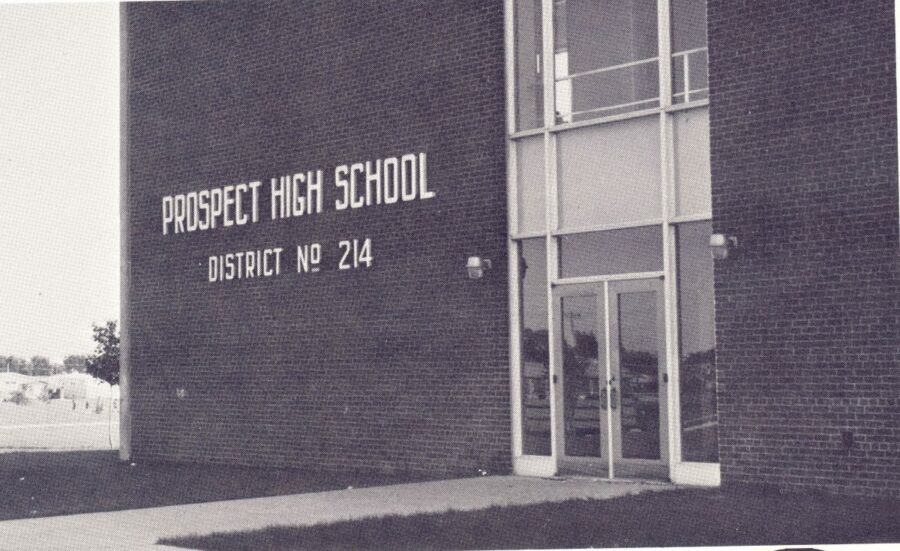
Prospect High School

School District: 214

Grade levels: 9-12

Built: 1956-57

Is it still standing? Yes

Is it still a school? Yes

History

Around the turn of the century there was a discussion about the need for a high school in the northwest suburban area. There was a lot of opposition to the founding of a new school, at least in part because much of the community was still agricultural and very conservative and they did not want the government to spend money on education. At the same time, there was also a national discussion about voting rights. Women still did not have the right to vote. Some states, mostly on the east coast, had passed laws either giving women complete or partial voting rights starting in the 1800s. Illinois gave women the right to vote for school board members in 1891 but did not grant them the right to vote for the U.S. President and local offices or referendums until 1913. Even then, women were not allowed to vote for state representatives, congressmen, or the governor and because of this, women had to use separate ballots and separate voting booths. Finally in 1920 the 19th amendment was passed and women were given full voting rights nationally. This all relates to the history of Prospect High because it was in 1914 that an election was held to found a high school district for Wheeling, Elk Grove, and Palatine Townships and because of the change in the Illinois state law in 1913, this was the first election women were allowed to vote in. Because of the women’s vote, the referendum passed. Had only the men’s votes been counted, the referendum would have failed. The conservative people who had opposed the founding of a high school contested the legality of this vote until it was finally upheld in the Illinois Supreme Court in 1922. The School District built Arlington High School on Euclid road, which served the entire region for years.

In early 1950, with an increasing population, a referendum was held to build a second high school in the area. This was again opposed by many of the conservative community members and the referendum failed the first two years it was proposed. By 1956 students were forced to attend Arlington High in shifts and the community finally supported the referendum, although, by then the land prices and constructions cost had risen so quickly that the project cost far more than it would have two years earlier. Construction began immediately and the school open in 1957. The first year the school only served freshmen and they added a new grade level every following year for three years. The school has gone on to have a long legacy, far outlasting Arlington High. The sports teams and bands have won statewide and national acclaim.

Filed Under: Schools of Mount Prospect

August 6, 2012

Maryville Academy

Grade levels: K-12

Built: First building 1882

Second building 1899

Is it still standing? Yes

If not, when was it demolished? First building burned in 1899 and was rebuilt

Is it still a school? Yes

History

Maryville is one of the oldest and most famous schools in the northwest suburbs. In 1880 Archbishop Patrick A. Feehan came to Chicago and was confronted with young boys who were living on the streets and were forced to steal to stay alive. He turned to wealthy church members and was able to raise funds to purchase land for the founding of a institution to help aid these children. In 1882 Archbishop Patrick A. Feehan purchased the 440 acre River Bend Knott Farm with the plan to transform it into a training school for boys. He hoped to be able to teach the young boys both academic programs and the skills that they would need to be “productive citizens of the world.” It was originally called Saint Mary’s Training School for Boys and started with four Christian Brothers, one of which was Bernard Fackeldey AKA Brother Teliow, who became the first supervisor of the school. The first class was approximately 30 young boys from Chicago. By 1883 the school housed over 120 students. The early founders believed in being open to boys from all races, religions and backgrounds, so they admitted 51 young Native American boys from the Sioux and Chippewa tribes. However, these students had been relocated by the federal government from reservations in the Southwest and were not prepared for the harsh winters. Five of these students died in the first year and the others were returned to their home reservations.

In 1887 the school purchased the neighboring Parmalee Farm, adding 400 acres to the schools holdings. By the early 1890s the school had grown to over 325 students, most of whom were Cook County wards. In 1899 a fire consumed most of the school, however the Catholic Churches in the area rallied together and raised enough money to rebuild the facility and enlarge it to house up to 1600 students. In 1902 Archbishop Feehan died and was replaced by James E. Quigley. One of the most important things that Quigley did was to make the school co-educational. In 1906 Quigley replaced the Christian Brothers with the Sisters of Mercy in preparation and in 1911 the school became co-ed. The student population reached its highest levels in the 1930s, when many families were not able to support their children. In 1950 the school held a contest to rename the institution. The name that was chosen was “Maryville, City of Youth.” In the 1960s and 1970s, the enrolment shrank as many social workers began to favor foster homes over institutional housing. The school was shaken at the end of 2002 with the suicide of a resident student. This brought on a critical review of the institution, which showed some serious issues, and major changes to the administration and operations of the school were undertaken.


Filed Under: Schools of Mount Prospect

August 6, 2012

Lions Park School

School District: 57

Grade levels: K-8

Built: First building 1956

Second building 1995

Is it still standing? First no, second yes

If not, when was it demolished? First building demolished in 1993 to make way for second

Is it still a school? Yes

History

The first Lions Park School was built in 1956 at the height of Mount Prospect’s explosive post war expansion. The population grew from around 4,000 to around 19,000 between 1950 and 1960, and most of these new residents were young families. This created a massive imbalance in the number of students and the school facilities. New schools were built at a dizzying rate, although this happened with some serious resistance, as the older established community watched their town radically change. One major issue that came about because of this massive development in such a short time was that all the children grew up at about the same time. With shifting demographic trends, many of the schools built in Mount Prospect in the 1950s were closed and demolished. Lions Park was one of the schools that survived the 1970s and 1980s, but as the demographic trends started to shift again with rising enrolments in the 1990s, many schools in Mount Prospect were found to be inadequate. Beginning in 1993, School District 57 began attempting to pass a referendum to build new facilities. After the referendum failed twice, it finally passed by a thin margin on the third attempt. Ironically, the people voting against the referendum were the same people who had moved to the community in the 1950s, insisted on the construction of many new schools, and faced opposition from the residents who had lived here longer. With the passage of the referendum, School District 57 had $13.5 million to modernize their facilities. The original Lions Park and Fairview Schools were raised, as the environmental issues in the buildings made it impossible to renovate and expand them. New Lions Park and Fairview Schools were built on top of the locations of the original schools and the new Lions Park School was opened in 1995.

In 1998 Lions Park School hosted a visit from then first lady Hillary Rodham Clinton and then senator Mosely Braun. The 5th graders at Lions Park School also participated in a 24 hour space shuttle simulation with students of Fairview school in 2001.

Filed Under: Schools of Mount Prospect

  • « Go to Previous Page
  • Page 1
  • Interim pages omitted …
  • Page 61
  • Page 62
  • Page 63
  • Page 64
  • Page 65
  • Interim pages omitted …
  • Page 131
  • Go to Next Page »

Primary Sidebar

Recent Posts

  • Holiday Housewalk 2025
  • Cleopatra to Visit MPHS
  • Holiday Family Fun in December

Community Links

  • Journal and Topics Media Group
  • Mount Prospect Public Library
  • The Daily Herald
  • Village of Mount Prospect

Forms

  • Pandemic 2020 Release Form

Resources

  • Central School
  • MP Lost and Found
  • On-Line Activities
  • On-Line Resources

Social Networks

  • Facebook MPHS
  • Twitter

Footer

Please follow & like us :)

Facebook

Mount Prospect Historical Society
101 South Maple Street
Mount Prospect, IL 60056
847.392.9006
info@mtphistory.org

The Mount Prospect Historical Society is a 501(c)(3) nonprofit organization that is committed to preserving the history of Mount Prospect, IL, through artifacts, photographs and both oral and written memories of current and former residents and businesspeople.  On its campus in the heart of the Village, the Society maintains the 1906 Dietrich Friedrichs house museum, the ADA-accessible Dolores Haugh Education Center and the 1896 one-room Central School, which was moved to the museum campus in 2008, renovated and opened to the public in 2017, the 100-year anniversary of the Village.

Archives

Copyright © 2025. ALL RIGHTS RESERVED · Mount Prospect Historical Society Log in