• Skip to primary navigation
  • Skip to main content
  • Skip to primary sidebar
  • Skip to footer

Mount Prospect Historical Society

#wrap

  • About Us
    • Our Museum
    • History
    • Virtual House Tour
    • Hometown History Video Series
    • Vanished Mount Prospect
    • Guided Tours of Dietrich Friedrichs Historic House Museum
    • Presentations
    • Dollhouse Tours
  • Shop
  • Volunteer
  • Donations/Membership
    • Donate
    • Donate an Artifact
    • Giving Tuesday
    • Membership
  • Events
    • Game Nights
    • Holiday Housewalk 2025
    • Saturday Afternoon Teas
    • Bessie’s Workbasket
    • Evening Creations
    • MPHS Book Club
    • Youth Programs
    • Cemetery Walk at St. Paul Lutheran Cemetery
  • Newsletters
  • Central School
    • For Educators
    • Donors
  • Research Resources
    • Pandemic Moments 2020-21
      • COVID-19 Survey 2021
      • Contributing to Pandemic Moments
      • Personal Accounts
      • Youthful Insights
      • Contact Release Form web format
      • Contact Release Form in PDF format
      • Pandemic Reflections
    • Mount Prospect Businesses
    • Churches of Mount Prospect
    • Essays on Mount Prospect’s History
    • Houses of Mount Prospect
    • Lost and Found Mount Prospect
    • Mount Prospect People
    • Schools of Mount Prospect
    • Mount Prospect Stories
    • Structural Memorials
    • Other Sources for Research
    • Centennial 2017
    • Neighborhood Walking Tours
  • Subscribe!

HS Board

June 29, 2021

The Mount Prospect Park and Shop: A Hidden History

by Marni Pyke – March 2021

When most people think of a historic site, a shopping center usually isn’t the image they conjure up. Imposing Victorian mansions or places like expansive battlefields seem old and unique in the 21st-century world, making them worthy of consideration as a historic site. Shopping centers, on the other hand, are a relatively modern addition to the American landscape and they seem to be everywhere. What could possibly be historic about a place like that?
Despite assumptions to the contrary, shopping centers, like Prospect Place in downtown Mount Prospect, have a historical context. Although this local shopping center is about to undergo redevelopment, the center itself is a product of earlier redevelopment.

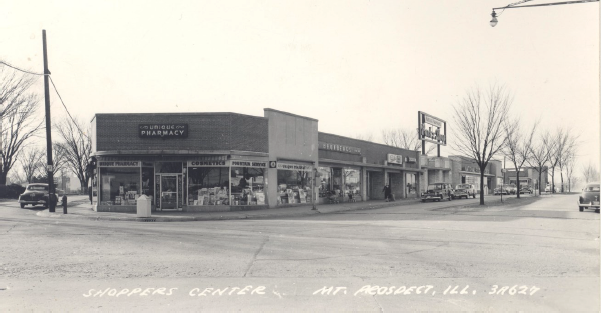
Mount Prospect Park and Shop, c.1950s

The 1923 Drainage District Map indicates that the land on the corner of today’s Main Street and West Prospect Avenue belonged to a farmer named George Meier. It’s unclear exactly when Meier sold his land, but the Weller Creek Drainage District office ledger, which recorded land payments, shows that by late 1940 a woman named Stella C. Wilson was making payments on the property. Later in the 1940s it was the site of the annual Lions Club Fall Festival. Whenever the sale occurred, Meier was one of many local farmers during these decades who sold their farmland to investors or developers looking to build new neighborhoods.

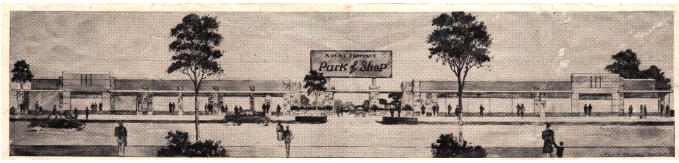
However, the northern part of Meier’s property was destined to become the site of “one of the most modern and unusual store developments in the entire Chicago area,” according to a February 11, 1950 issue of Realty and Building magazine. This store development was originally named the Mount Prospect Park and Shop and was designed by architect Edward P. Steinberg.

The term “park and shop” was commonly used in the mid-1900s to refer to a shopping center that also provided nearby parking spaces. 21st-century Americans might instead consider a similar structure a strip mall. This type of shopping center represents an important change in retail history and in the development of the suburbs. In retail history, park and shop centers mark a change in architecture that accommodates customers and their cars. Park and shop centers were, in theory, a way to solve the congestion issues caused by increasing numbers of cars on the road.

For Mount Prospect, the park and shop served to accommodate a growing population and was a way to keep
residents shopping in downtown areas, rather than on the outskirts of town or, more significantly, in neighboring towns.

When Mayor Pendleton shoveled the first scoop of dirt during the May 1950 groundbreaking ceremony, the $250,000 Mount Prospect Park and Shop Center was planned to hold eight or IN THIS ISSUE: nine stores. The
Park and Shop opened for business in fall 1950, and the entire block of stores was completely full by the end of 1952.

Some of the earliest tenants at the Park and Shop were Reid’s Ladies Apparel, Sethness Men’s Store, Brunberg’s 5 & 10, Lenhart’s Pastry Shop, Bachmann’s Hardware Store, the National Food Store, and McMahon’s Dry Goods. While none of these early tenants remain in the shopping center, other tenants became fixtures. Keefer’s Pharmacy, Strass’ Ladies Apparel (later Mary Jayne’s Ladies Apparel), and Sam’s Place were or have been located in the Park and Shop for over 40 years.

Although the style of a park and shop center was supposed to relieve traffic congestion, the one in Mount Prospect had the opposite effect. The Mount Prospect Herald reported in December 1950, only a few months after opening, that the Village had recently imposed a two-hour parking limit on south side of West Prospect Avenue in order to
“accommodate the new stores.” Another suggestion to improve traffic involved creating a driveway space leading into the Park and Shop parking lot through the central island of grass and trees down Prospect Ave. These parking issues were part of larger downtown parking problems throughout the 1950s, so the Village eventually asked a commission to study the situation.

Over the following decades, the name “Park and Shop” disappears from the records. It seems that the Park and Shop became part of the Village landscape as the rest of the street filled in with new retail space. The building is currently called “Prospect Place Shopping Center,” but there are no records of when or why the name changed. (If you know the answer to this history mystery, please contact the Historical Society!) Though the name may be mysterious, the Prospect Place sign with the clock is instantly recognizable in the downtown landscape.
At the time of writing, the Village has approved plans to replace the shopping center with a five-story building containing first floor commercial space and apartments above. It appears that this land along West Prospect Avenue will continue the cycle of redevelopment, but this time in a new century.

Sketch of the proposed Mount Prospect Park and Shop in Realty and Building magazine, February 1950

Filed Under: newsletter

June 28, 2021

Hanul Family Alliance Powered through COVID

Serving Korean immigrants . . . and others

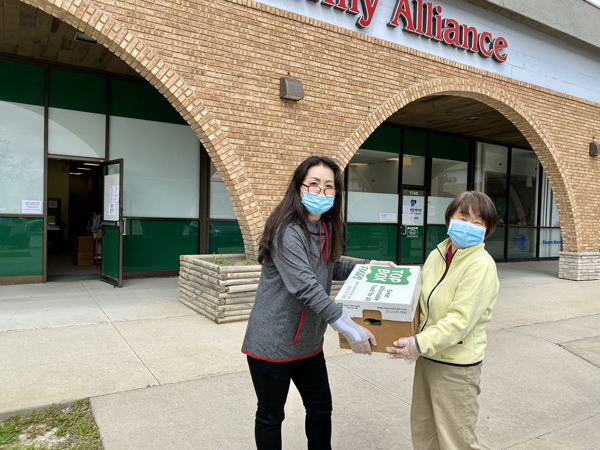
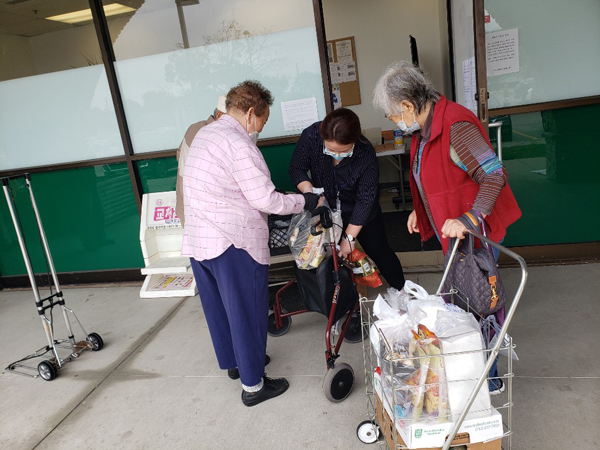
The Hanul Family Alliance has been a part of the Mount Prospect community since 1999. Located at 1166 S. Elmhurst Rd., it serves the needs of the immigrant – primarily Korean – population through congregate dining and home-delivered meals for those over 60, public benefits application assistance, assistance in applying for the Low Income Home Energy Assistance Program, home care services for those over 60, citizenship applications, mental health counseling, English as a Second Language (ESL) classes and other cultural and educational programs.

Hanul (which means “one large family” in Korean) Family Alliance was founded in Chicago’s Albany Park neighborhood in 1987 as a Korean American Senior Center to meet the needs of primarily limited-English-speaking Korean elderly. It opened a suburban location in Mount Prospect in 2004 and further expanded to Lake County in 2012.

Today, the agency annually serves over 10,000 individuals and families of all ages (1,000 from Mount Prospect alone) by providing a broad range of community services to meet the diverse needs of community members. Since 2006, Hanul also serves as a resource center for a wide variety of other nearby ethnic populations. 

“Our three different offices conveniently serve our Korean American community spread throughout the Metropolitan Chicago area,” explained Yihyun Kim, manager of the Mount Prospect office of Hanul. “We serve a large population of Low English Proficient Korean American older adults and also low-income immigrant families and primarily focus on promoting healthy aging, family wellness and community engagement.”

The COVID-19 pandemic of 2020-21 created challenges and barriers for Hanul staff and patrons, just as it did for everyone else – in the world! 

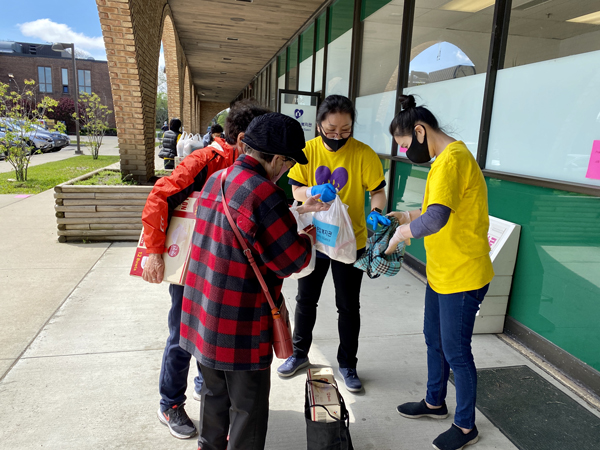
“Our staff had to resort to working from home and congregate dining for older adults was no longer allowed,” Kim related. “Instead of the daily congregate dining, we provided lunch pick-up services two days a week. Staff provided public benefits application assistance virtually and allowed clients to drop off necessary documents through a mail drop-in box at the office. Our in-person classes moved to Zoom and YouTube livestream. We knew these programs were essential to our most vulnerable community members and it was our mission to find innovative, yet safe, ways to deliver the programs to our clients.”

Hanul staff members dealt with increased call volumes. They also attended training to appropriately provide clients with additional services like applying for unemployment insurance, filing COVID-19 emergency cash fund applications, applying for rental and mortgage assistance and more. 

“There has been increased demand for assistance with these COVID-19-related programs and services and the number of clients we can serve has decreased since each case management takes longer when done virtually,” Kim said, so this had put added pressure on Hanul’s staff. 

Annual events like Hanul’s Purple Ball fundraiser, Korean Seniors Day and Youth Science Day were postponed, but they held their first-ever virtual fundraising gala which was very successful.

For more information about Hanual, visit their website at https://hanulusa.org/.

Filed Under: Personal Accounts

June 15, 2021

Nausheen Khan

Filed Under: Pandemic Essays

  • « Go to Previous Page
  • Page 1
  • Interim pages omitted …
  • Page 14
  • Page 15
  • Page 16
  • Page 17
  • Page 18
  • Interim pages omitted …
  • Page 131
  • Go to Next Page »

Primary Sidebar

Recent Posts

  • Help Us Celebrate Our Semiquincentennial
  • Holiday Housewalk 2025
  • Cleopatra to Visit MPHS

Community Links

  • Journal and Topics Media Group
  • Mount Prospect Public Library
  • The Daily Herald
  • Village of Mount Prospect

Social Networks

  • Facebook MPHS
  • X (Twitter)

Footer

Please follow & like us :)

Facebook

Mount Prospect Historical Society
101 South Maple Street
Mount Prospect, IL 60056
847.392.9006
info@mtphistory.org

The Mount Prospect Historical Society is a 501(c)(3) nonprofit organization that is committed to preserving the history of Mount Prospect, IL, through artifacts, photographs and both oral and written memories of current and former residents and businesspeople.  On its campus in the heart of the Village, the Society maintains the 1906 Dietrich Friedrichs house museum, the ADA-accessible Dolores Haugh Education Center and the 1896 one-room Central School, which was moved to the museum campus in 2008, renovated and opened to the public in 2017, the 100-year anniversary of the Village.

Archives

Copyright © 2026. ALL RIGHTS RESERVED · Mount Prospect Historical Society Log in