• Skip to primary navigation
  • Skip to main content
  • Skip to primary sidebar
  • Skip to footer

Mount Prospect Historical Society

#wrap

  • About Us
    • Our Museum
    • History
    • Virtual House Tour
    • Hometown History Video Series
    • Vanished Mount Prospect
    • Guided Tours of Dietrich Friedrichs Historic House Museum
    • Presentations
    • Dollhouse Tours
  • Shop
  • Volunteer
    • 2026 Junior Camp Counselor Information
  • Donations/Membership
    • Donate
    • Donate an Artifact
    • Giving Tuesday
    • Membership
  • Events
    • Game Nights
    • Holiday Housewalk 2025
    • Saturday Afternoon Teas
    • Bessie’s Workbasket
    • Evening Creations
    • MPHS Book Club
    • Youth Programs
    • Cemetery Walk at St. Paul Lutheran Cemetery
  • Newsletters
  • Central School
    • For Educators
    • Donors
  • Research Resources
    • Pandemic Moments 2020-21
      • COVID-19 Survey 2021
      • Contributing to Pandemic Moments
      • Personal Accounts
      • Youthful Insights
      • Contact Release Form web format
      • Contact Release Form in PDF format
      • Pandemic Reflections
    • Mount Prospect Businesses
    • Churches of Mount Prospect
    • Essays on Mount Prospect’s History
    • Houses of Mount Prospect
    • Lost and Found Mount Prospect
    • Mount Prospect People
    • Schools of Mount Prospect
    • Mount Prospect Stories
    • Structural Memorials
    • Other Sources for Research
    • Centennial 2017
    • Neighborhood Walking Tours
  • Subscribe!

HS Board

June 13, 2012

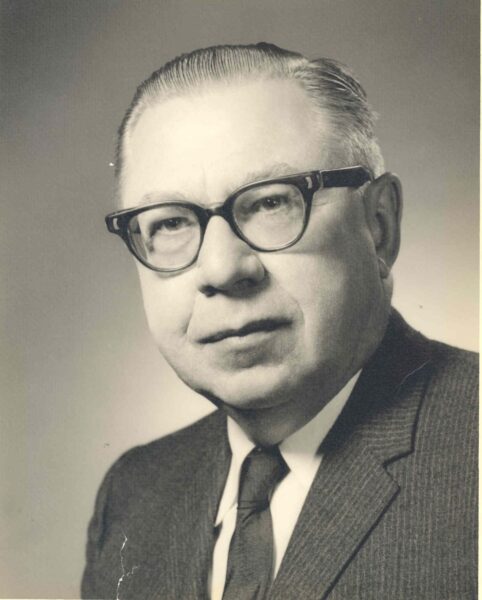
Clarence (C. O.) Schlaver

Does MPHS have photographs: Yes

Address in Mount Prospect: 400 S. I-Oka

Birth Date: 1905

Death Date: February 12, 1980

Marriage
Date:

Spouse: Elizabeth (Betty)

Children: David, Marcia, Paul

Interesting information on life, career, accomplishments

C. O. Schlaver grew up on a farm in Sparta, Wisconsin. From this “hands on” experience, he learned to hate farms. He moved off the farm, went to the University of Wisconsin’s School of Journalism and headed off to become a reporter. He moved to Mount Prospect and was much better known as a journalist, activist and politician. Clarence Schlaver was involved in local politics for thirty years in a number of different roles. He was a village Trustee for seven years beginning in 1954 and ending when he was elected Mayor in 1961. He founded the Good Neighbor Party in local politics, a group dedicated to the extension of services in the community. Through his leadership and the actions of the party, many of the municipal and educational services we have come to rely on were started.

C.O. Schlaver worked in the newspaper business in one form or another for many years. He was for a time a reporter and editor for the Star-Courier and later on the editorial staff of the Chicago Daily News. He printed his own small newspaper on Mount Prospect for a number of years, as well as helping a number of local students put together their own papers. He was the first full time editor of “The Quill” the monthly publication of Sigma Delta Chi, the national professional journalism society.

Schlaver was also involved with a number of other organizations. In 1972 he became the Executive Director of the Mount Prospect Chamber of Commerce a position he held until 1979, shortly before his death. He was a founding member of the Mount Prospect Historical Society, and involved with the Lions Club both at a local and state wide level.

Filed Under: People of Mount Prospect

June 13, 2012

Owen Rooney

Does MPHS have photographs: No

Address in Mount Prospect: 15 S. George Street

Birth Date: Circa 1815

Death Date: Circa 1875

Marriage
Date: Unknown

Spouse: Ann

Children: Peter, William, James, Joseph, Michael, Edward, and Mary Ann

Interesting information on life, career, accomplishments

The oldest house in Mount Prospect originally belonged to Owen Rooney. It has been suggested that his son, William may have been the original builder but that is not born out by Federal Census data. William may have also owned farm land in Mount Prospect but it is not clear. It is it also not clear exactly when the house was built. Some people have made statements that it was built as far back as 1832, although that is not consistent with the historical context. There was no real settlement in the area before the conclusion of Black Hawk’s War and the treaty of 1833. As well, Owen Rooney was born in Ireland and would have been about 16 or 17 in 1832, a little young to have immigrated across the Atlantic and have bought a farm and built a house. This would have preceded the large scale Irish immigration to the United States by about 14 years. There are records of Owen Rooney being in Wisconsin in 1846. In 1847 there is a record of him buying 160 acres of land in Elk Grove Township, but the first record we have of him living in Elk Grove Township is not until the 1860 Census. He most likely built his house in the early 1850s. By then there would have been a railroad going through the area, although there was no station in Mount Prospect, and there would have been a lumber mill that could have provided the wood needed to build a frame house. What is known is that most of the area subdivided by Ezra Eggleston in 1874 had been the Rooney farm, so most of downtown was originally his farm. It is also not clear when Owen Rooney died, although he is listed in the 1870 Census in Elk Grove and is not listed in the 1880, although his wife and most of his family is, although no longer in Elk Grove.

Filed Under: People of Mount Prospect

June 13, 2012

John Pohlmann

Does MPHS have photographs: Yes

Address in Mount Prospect: 1 S. Owen

Birth Date: 1889

Death Date:

Marriage
Date: 1915

Spouse: Anna Meyer

Children: Three children

Interesting information on life, career, accomplishments

John Pohlman was born in Mount Prospect in 1889. He had fifteen siblings and his family therefore made up a large percentage of Mount Prospect’s population, which was still fewer than 100. At the age of 6, John Pohlman became one of the first 5 students to attend the Central School, Mount Prospect’s first school. At 20 he became the Station Master for the Chicago Northwestern Railroad in Mount Prospect. He worked in the Mount Prospect train station for the next 45 years. He was one of the organizers of the Mount Prospect Improvement Association and then was later one of the first Board of Trustees. He was also a charter member of Saint Paul Lutheran Church and the Mount Prospect Volunteer Fire Department. Below is a selection of an oral history of John Pohlman.


John W. Pohlman; Interviewed by Delores Hough; November 24, 1969

Complete transcript available at the Mount Prospect Public Library.

JP: …we had one comical conductor on the Northwestern years and years back, and right in back of Kruse’s there was a farmer there who worked that land, and he had crashed at a big straw stack out there, and he was a comedian, you might call him, and called it “Monstrawstack,” and that name carried on for years. I remember it when I started, way back, people would say, “Oh, you’re working down at Monstrawstack.” “Where do you get that?” I knew it was called that, but out-of-town people would call it “Monstrawstack.” “That’s where you work.” At the time of my beginning at the railroad there was not much of Mount Prospect.

DH: What year did you start on the railroad?

JP: I started in ninth month, the tenth, 1910. Is there anybody old enough to remember?

DH: How many trains did you have a day, going each way?

JP: Well, now, I think we had three in the forenoon and one around three-thirty, and then again about six-thirty. That was last. If you got hung up on the other end, you’d do like this. Of course, in those days you would never get home.

JP: Yes, well, he’s the man who put me to work. He was superintendent for this division at the time when I started. When I walked in there looking for a job, he said, “Well, what can you do? Can you push a pencil?” I said, “Well, I think I can.” “What education did you have?” Well, I had four months of business college outside of fourth grade. Well, we had no grade — we had fourth reader. What did they call them? Fourth readers.

DH: That probably was beyond fourth grade, though.

JP: Oh, yes. That was beyond that, of course. In those days it was reading, arithmetic, geography and history. That’s all we…

DH: How much of that did you study in German _________ high school?

JP: In German?

DH: Yes.

JP: One September to the other September, and from September to Easter when I was confirmed — a year and a half.

DH: And everything was German?

JP: Everything was German — no, they had an English reader then.

DH: Do you remember the time…the big snowstorm?

JP: That was in the year of 1917 and 1918. Do I remember it? Yes. I’ll tell you a little story about that, how people lived together in Mount Prospect, the few we had. The freight handlers — now, Charlie Mackleburg, who lives on Nolan Street near me there, he was one of the boys who was working freight, as was his father and so forth, and a couple of other fellows, and no train came. No train coming. Old Fred Mackleburg said to me, “John, the least you could do is furnish us with a deck of cards and a case of beer.” I’ll never forget it. So what did the guys do, like Herman Haas who lives on Mount Prospect yet — he was one, well, he was a linotype man _________ printing _________, so he got the idea, and he said, “Well, let’s all chip in a quarter.” There was Charlie Mackleburg and Louie Mackleburg, who has passed away, and I don’t know who the other one was, but three of them. They went across to Kruse’s and told them the story of what they wanted in there, and old Clarence opened up and gave them a deck of cards and a case of beer, and then he threw in a bottle of whiskey on top of it. About two o’clock in the afternoon, no train around yet. The beer was gone and whiskey was gone, so old Fred Mackleburg said, “Well, boys, I don’t think we have to wait for the train now anymore, and he was feeling his — and he said, “I’m going home.” And there was no train. I had mail hanging on the post. And there was no telephone.

Filed Under: People of Mount Prospect

  • « Go to Previous Page
  • Page 1
  • Interim pages omitted …
  • Page 103
  • Page 104
  • Page 105
  • Page 106
  • Page 107
  • Interim pages omitted …
  • Page 132
  • Go to Next Page »

Primary Sidebar

Recent Posts

  • From Wright to Bradbury: A Day Trip to SC Johnson Wax and Carnegie Library
  • MPHS 250th Celebration Events
  • Help Us Celebrate Our Semiquincentennial

Community Links

  • Journal and Topics Media Group
  • Mount Prospect Public Library
  • The Daily Herald
  • Village of Mount Prospect

Social Networks

  • Facebook MPHS
  • X (Twitter)

Footer

Please follow & like us :)

Facebook

Archives

Mount Prospect Historical Society
101 South Maple Street
Mount Prospect, IL 60056
847.392.9006
info@mtphistory.org

The Mount Prospect Historical Society is a 501(c)(3) nonprofit organization that is committed to preserving the history of Mount Prospect, IL, through artifacts, photographs and both oral and written memories of current and former residents and businesspeople.  On its campus in the heart of the Village, the Society maintains the 1906 Dietrich Friedrichs house museum, the ADA-accessible Dolores Haugh Education Center and the 1896 one-room Central School, which was moved to the museum campus in 2008, renovated and opened to the public in 2017, the 100-year anniversary of the Village.

Contact Us!

Copyright © 2026. ALL RIGHTS RESERVED · Mount Prospect Historical Society Log in