• Skip to primary navigation
  • Skip to main content
  • Skip to primary sidebar
  • Skip to footer

Mount Prospect Historical Society

#wrap

  • About Us
    • Our Museum
    • History
    • Virtual House Tour
    • Hometown History Video Series
    • Vanished Mount Prospect
    • Guided Tours of Dietrich Friedrichs Historic House Museum
    • Presentations
    • Dollhouse Tours
  • Shop
  • Volunteer
  • Donations/Membership
    • Donate
    • Donate an Artifact
    • Giving Tuesday
    • Membership
  • Events
    • Holiday Housewalk 2025
    • Saturday Afternoon Teas
    • Bessie’s Workbasket
    • Evening Creations
    • MPHS Book Club
    • Youth Programs
    • Cemetery Walk at St. Paul Lutheran Cemetery
  • Newsletters
  • Central School
    • For Educators
    • Donors
  • Research Resources
    • Pandemic Moments 2020-21
      • COVID-19 Survey 2021
      • Contributing to Pandemic Moments
      • Personal Accounts
      • Youthful Insights
      • Contact Release Form web format
      • Contact Release Form in PDF format
      • Pandemic Reflections
    • Mount Prospect Businesses
    • Churches of Mount Prospect
    • Essays on Mount Prospect’s History
    • Houses of Mount Prospect
    • Lost and Found Mount Prospect
    • Mount Prospect People
    • Schools of Mount Prospect
    • Mount Prospect Stories
    • Structural Memorials
    • Other Sources for Research
    • Centennial 2017
    • Neighborhood Walking Tours
  • Subscribe!

Archives for July 2012

July 16, 2012

Saint John Lutheran Church

When was it founded: 1848

Where is it located: 1100 Linneman Road

Has it moved: No

Notable Members: All the early German Lutheran founders

First Pastor or Priest: Clements Klein

History and interesting stories about the church:

In 1848, Pastor Francis A. Hoffman, a German immigrant from Schaumburg, came to what-was-then the Elk Grove area to preach in the native tongue of the Lutheran Germans who had settled the area. By establishing a parish based on a common language, Pastor Hoffman believed the conservative religious traditions vital to the German culture would be easier to adhere to. Some founding members of the congregation were also prominent members of Mount Prospect: Frederich Busse, Christian Heinrich, Christian Linnemann, and Conrad Moehling.

As with other churches started in the Mount Prospect area, a community effort was made to both build and fund the congregation’s new home. Money was collected, construction was completed, and eventually, a church was dedicated on December 26, 1848. Immediately following the dedication, Pastor Hoffman installed Pastor Clements Klein to the church. However, his stay as pastor was brief, lasting only a year; so, in 1850, the congregation was forced to welcome Pastor John G. Kuntz. During his term of service to the church, Pastor Kuntz established a cemetery and was involved in Saint John’s decision to affiliate with the Missouri Synod in 1852. The year after the affiliation served to be a year of “new,” as a new pastor was installed, Karl Sallmann, and a new church building was constructed. Although the church experienced hardships in the form of a parsonage fire and the subsequent destruction of congregational records in 1859, Saint John, under the guidance of Pastor William Bartling, enjoyed relative peace during the Civil War years. This peace continued for the church following Pastor Bartling’s departure and Pastor Henry Schmidt’s installation. Under the leadership of Pastor Schmidt, Saint John gained not only a new school facility in 1864, but an expanded congregation as well. It was because of the latter achievement that Pastor Schmidt was nicknamed “the Missionary.”

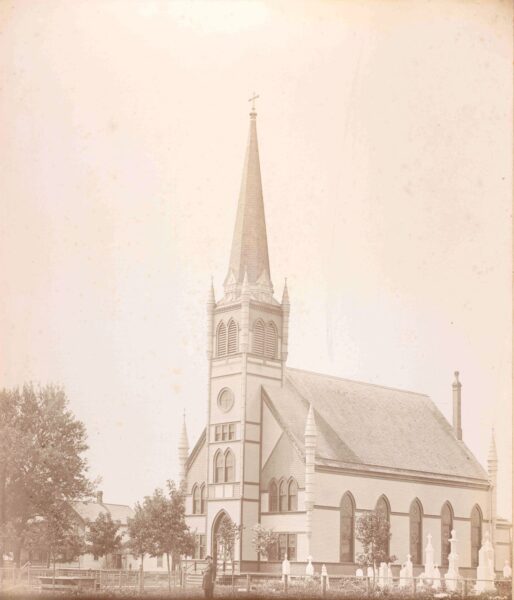
Following Pastor Schmidt in the pulpit were men who brought with them leadership, guidance, and significant changes to the church and its surrounding community. Pastor William Dorn influenced and witnessed Saint John’s first bell and steeple in 1874; while, Pastor Herman Ramelow preached to the congregation during the church’s support of an Addison orphanage, Kinderheim, in 1879. He also helped to form a congregational band in 1881. Affectionately called “the Builder” by parishioners, Pastor J. Henry Haake was responsible for the rebuilding of the church in 1892, the schoolhouse in 1901, and the parsonage’s north wing in 1904. Further under his leadership, Saint John became incorporated and celebrated its 50th anniversary. In 1907, perhaps a sign of the changing times, the church’s wood walls and ceilings were fortified with metalworkings under Pastor Julius Drexler. Pastor Louis Millies witnessed and perhaps instigated the departure of thirteen parishioners who eventually founded another church and parish school: Saint Paul Lutheran Church.

Since its initiation in 1848, Saint John has been plagued with the “revolving door” syndrome concerning its pastors. Few if any have lasted long enough to sit down and leisurely enjoy a cup of tea. However, Pastor Ferdinand Gehrs managed to escape from the revolving door’s glass prison and become Saint John’s longest-serving pastor. Throughout his forty-three year term, he has both observed and supervised various changes at Saint John. Some of those changes were physical and inconsequential, such as the installation of a new altar and Jesus statue in 1921, while, others were not as tangible and yet highly significant–the offering of English-speaking services in 1922. It can be inferred that the shift from German to English-speaking services was Saint John’s attempt at establishing a relationship with the non-German populace as well as to distance itself from the unpopular image of Germans following World War I. This gradual self-destruction of German heritage continued, reaching its climax in 1940 following the Allies’ declaration of war on Hitler’s Germany, when German was dropped from the parish school’s curriculum and English was more intensely incorporated. The World Wars also adversely impacted Saint John’s congregation, permanently taking away five men including Adolph Busse Jr. In 1948, the church valiantly celebrated its Centennial amid the public’s still fresh anti-German sentiments. Eventually, those negative feelings subsided and Saint John was once again a pride of the community. In 1954, still under the direction of Pastor Gehrs, a new parsonage was constructed. Unfortunately, he was only able to occupy the parsonage for two years before resigning in 1956.

Following Pastor Gehr’s departure was the installation of Pastor Waldemar Streufert. Although he did not achieve the former’s record in longevity, Pastor Streufert certainly was a catalyst for considerable changes at Saint John. As the congregation grew yearly, it became increasingly difficult to keep all of the congregates informed about the church. So, in response to this glaring failing, Pastor Streufert began to print an informative church newsletter, “The Herald,” highlighting Saint John’s various undertakings. In 1958, to reflect the post-war baby boom, a new school was built to house the upper-level grades. Fourteen years later in 1972, a new school building was constructed in response to the new residences sprouting up around Saint John. The era of suburban living had begun.

Amid the suburban population boom, Saint John celebrated its 125th anniversary in 1973 and its annexation to Mount Prospect three years prior. A year after the anniversary, Pastor Theodore Staudacher took over the church’s leadership from Pastor Streufert. Under his guidance, Bible school and youth groups were started; while, Pastor Streufert’s newsletter was continued with a different name, “The Contact.”

Unbeknownst to Saint John, strife within the Missouri Synod surfaced as conservatives and liberals clashed over various issues. A permanent schism had been formed and widened between the two parties, eventually leading to a split in the Synod. As a result of this division, conservative people from liberal Synod churches flocked to the established conservative congregation of Saint John.

In 1978, the parsonage built in 1954 was demolished; while, a year later, tragedy struck as the 87-year-old steeple collapsed. However, with Pastor Robert Kass at the helm, a new church steeple was installed and the church itself refurbished. Also, under Pastor Kass’s supervision, the Bethesda Group Home–designed to assist developmentally disabled adults–was built and dedicated in 1984. Nearly a decade later, in 1992, Pastor Jeff Gavin took over for Pastor Kass and made it his mission to increase the severely stunted membership at Saint John. A few years earlier, low student enrollment at Saint John’s school forced the discontinuation of grades 3 through 8. With congregation and student enrollment numbers down, Pastor Gavin hoped the addition of variety to the worship service would reverse the sliding trend. Yet despite those problems, in 1998, Saint John Lutheran Church celebrated 150 years in the community.
Filed Under: Churches of Mount Prospect

July 16, 2012

History Crawl is Here Again!

Mount Prospect Historical Society Combines Old and New at Third Annual Downtown “History Crawl” along Prospect Avenue

The Mount Prospect Historical Society will hold its third annual “History Crawl” on Friday, August 10, from 5 to 10 p.m. Pre-sale tickets can now be reserved through the Society’s website at www.mtphist.org or by visiting the Society at 101 S. Maple Street. This year, the event will feature select businesses along Prospect Avenue, which will allow the event to be more concise and allow for more entertainment: “We felt that focusing on one area of the downtown would make the event more manageable and easier to walk for attendees than in years past. We will further be able to increase the presence of live entertainment. There is also an additional element of safety with less crosswalks and stops to navigate. What better place to start than along what was once known as ‘Railroad Avenue’? It was for many years the principal location for commerce in the Village,” stated Greg Peerbolte, the Society’s executive director.

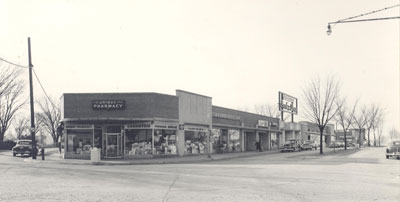
Shopper's Center on Prospect Avenue, circa 1950
Mount Prospect “Shopper’s Center” on Prospect Avenue, circa 1950.

As in years past, the Crawl will showcase local businesses from the past and present, as well as discuss some of the area’s hidden history through the use of some colorful “characters” from Mount Prospect’s past. Some of these local stories may sound like the stuff of a Hollywood blockbuster: “Expect to hear stories ranging from a buried gold cache, reputed Mafia ties, haunted buildings, prohibition-era bootlegging and bank robberies,” Peerbolte said.

Social media is playing a more visible role in the event this year. The History Crawl is partnering with Facebook and Foursquare to give the event a tech savvy flair. “We’re excited to embrace new technology to promote this year’s History Crawl. With the use of Quick Response or ‘QR’ codes, tickets to the event can be purchased anywhere an event poster is hung using a smartphone. The event also has its own Facebook page in which updates and additions to the event can be easily announced. Additionally, Foursquare’s ‘check-in’ feature will allow attendees to show their Facebook friends where they are at the event in real time,” Peerbolte continued.

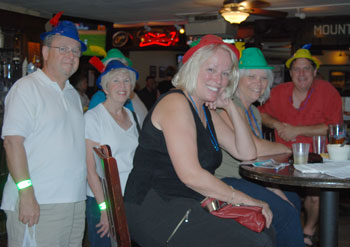
History Crawlers at Mrs. Pea and Me
A group of “crawlers” enjoy food, drink and a round of “Mount Prospect Trivia” at Mrs. P & Me at the 2011 Mount Prospect Historical Society’s Downtown History Crawl.

Crawl participants will also have an opportunity to wear Mount Prospect history home: “We are offering limited-edition, vintage style ‘Mother’s Pinball’ event t-shirts to participants for $12 with the purchase of an event ticket. Mother’s is one of Mount Prospect’s beloved institutions, housed in the general store building that is now home to Capannari’s Ice Cream,” Peerbolte commented.

All proceeds from the History Crawl will benefit the Society’s operating fund. The Crawl’s heretofore success has the Historical Society hoping that it will be a long-standing event: “The event’s immediate popularity was somewhat surprising,” remarked Peerbolte. “We drew over 100 attendees in our first year. At least three other historical agencies have contacted me for information on developing similar events in their respective communities. We really feel this event has the potential to become a mainstay both for the Historical Society as well as the community of Mount Prospect.”

For more information or to purchase tickets, contact Peerbolte at the Mount Prospect Historical Society at 847/392-9006 or e-mail him at gtpeerbolte@mtphistory.org.

Filed Under: Breaking News, Events

July 16, 2012

Saint John’s Episcopal Church

When was it founded: 1937-1938

Where is it located: 200 North Main Street

Has it moved: Yes

First Pastor or Priest: Father Hubbard (?)

History and interesting stories about the church:

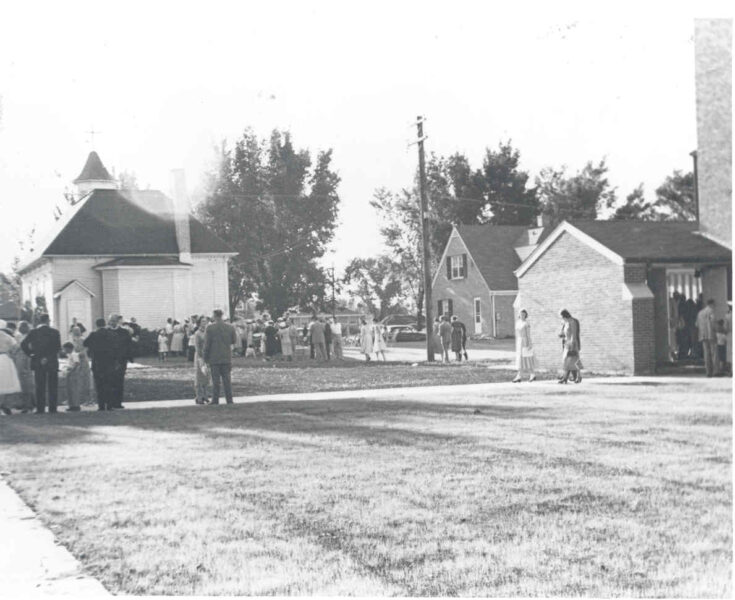
The first service for Saint John’s Episcopal Church was held on April 24, 1938 with the blessing of then-Bishop Stewart of Chicago. For the twenty people who received communion that day, a drinking glass served as the chalice, a cream pitcher as the cruet, and a saucer as the paten. In 1939 with the gift of two lots by realtors Krause and Kehe, Saint John’s was able to purchase the Central School property and hold services there. Despite having financial difficulties, the church managed to survive through the community’s collective efforts and support.

In 1946, following the end of World War II and amid the suburban living boom, Saint John’s welcomed Father Dean Howard Ganster. Three years later, Thomas Chaffee was received into the church as its first resident Priest-in-Charge. However, it was not until 1953 that Saint John’s was formally recognized and invited into the Diocese as a parish. In that same year, a new place of worship was built and dedicated by Bishop Burrill. In 1955, following Father Chaffee’s resignation, the church experienced a “revolving-door” issue with its clergy. Robert Manning arrived in 1956 and left a year later; while, his replacement, Father Ehrgott remained a mere four years until 1962.

Between 1953 and 1961, Saint John’s lost and regained its status as a self-supporting parish church. This seems to have been due, in part, to being over extended financially with the construction of the new church and founding of the Sunday School and in part because of divisions within the congregation. These divisions seem to have come from Father Manning taking a high-church approach and parts of the congregation finding this too rigid and leaving to found St. Simon’s Episcopal Church in Arlington Heights.


Filed Under: Churches of Mount Prospect

  • « Go to Previous Page
  • Page 1
  • Interim pages omitted …
  • Page 22
  • Page 23
  • Page 24
  • Page 25
  • Page 26
  • Interim pages omitted …
  • Page 36
  • Go to Next Page »

Primary Sidebar

Recent Posts

  • Holiday Housewalk 2025
  • Cleopatra to Visit MPHS
  • Holiday Family Fun in December

Community Links

  • Journal and Topics Media Group
  • Mount Prospect Public Library
  • The Daily Herald
  • Village of Mount Prospect

Forms

  • Pandemic 2020 Release Form

Resources

  • Central School
  • MP Lost and Found
  • On-Line Activities
  • On-Line Resources

Social Networks

  • Facebook MPHS
  • Twitter

Footer

Please follow & like us :)

Facebook

Mount Prospect Historical Society
101 South Maple Street
Mount Prospect, IL 60056
847.392.9006
info@mtphistory.org

The Mount Prospect Historical Society is a 501(c)(3) nonprofit organization that is committed to preserving the history of Mount Prospect, IL, through artifacts, photographs and both oral and written memories of current and former residents and businesspeople.  On its campus in the heart of the Village, the Society maintains the 1906 Dietrich Friedrichs house museum, the ADA-accessible Dolores Haugh Education Center and the 1896 one-room Central School, which was moved to the museum campus in 2008, renovated and opened to the public in 2017, the 100-year anniversary of the Village.

Archives

Copyright © 2026. ALL RIGHTS RESERVED · Mount Prospect Historical Society Log in